
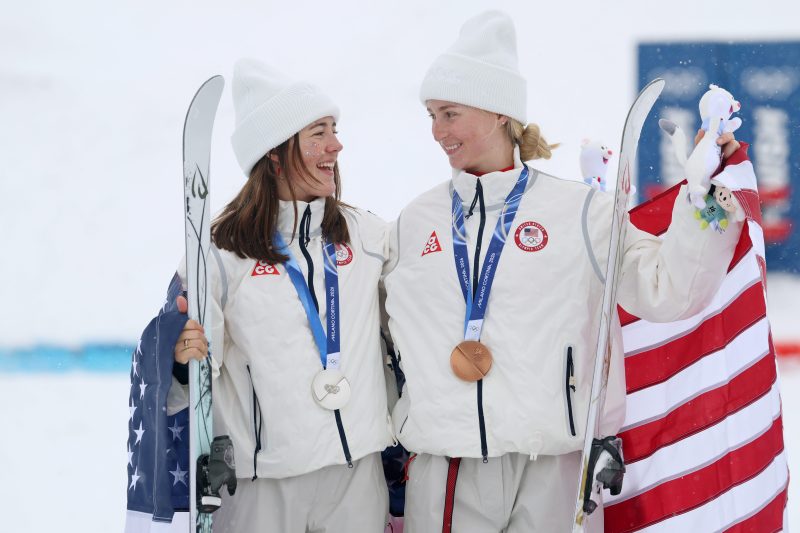
- American free skiers Jaelin Kauf and Liz Lemley won silver and bronze, respectively, in the Olympic debut of dual moguls.
- The two skiers are responsible for 25% of the total U.S. medals won at the 2026 Winter Olympics.
- Dual moguls, a new Olympic event, pits two skiers against each other in a head-to-head race.
- Four American skiers, half of the field, advanced to the quarterfinals of the knockout-style event.
LIVIGNO, Italy — The mogul mavens have put Team USA on their backs.
More than a week into the 2026 Winter Olympics, two United States free skiers are responsible for 25% of U.S. medals won.
In the Olympic debut of dual moguls – perhaps the most exciting addition to the program these Games – on Saturday, Jaelin Kauf won silver, same as she did in the classic moguls event four days earlier. Liz Lemley, her teammate who won a surprising gold in moguls, took bronze.
Australia’s Jakara Anthony, whose stumble in the single final gave the U.S. the top two spots on the podium, persevered to win gold. The other two Americans in the field, Tess Johnson and Olivia Giacco, advanced to the quarterfinals of the knockout-style event, meaning half of the final eight skiers wore the U.S. flag on their uniform. Beyond the American success, though, is the indelible excitement of the event.
Watch Winter Olympics on Peacock
“I think from the moment we woke up this morning, all of us girls were so excited and energized by the opportunity to be able to compete in the first-ever dual moguls, finally have it showcased on the Olympic stage,” said Kauf, who is now the most-decorated mogul skier in U.S. history with three career silver medals. “It was pretty spectacular.”
Johnson said she was buzzing regardless of the individual outcome for her. That’s the effect dual moguls has.
“We wanted to put on a show today, and I think that’s exactly what we did,” Johnson said. “Dual moguls breeds excitement and chaos. Anything can happen.”
Dual moguls, making its Olympic debut despite being a mainstay on the World Cup circuit, pits two competitors against each other at the same time. The one with the highest score moves on to the next round. The score is based on the judges’ assessment of turns (roughly 60%), aerials (20%) and time (20%), with five points available per judge for a maximum score of 35.
In the regular moguls, a fall ends an athlete’s day. Depending on the round, someone can fall and still walk away with a medal.
That’s actually exactly what Kauf and Lemley did, as they both crashed during their respective semifinal runs. Kauf’s semifinal opponent, Perrine Laffont, skied outside of the course. She saw out of the corner of her eye that Laffont had deviated off her line, but wasn’t exactly sure what happened – the perils of dual moguls.
“Sometimes when that happens you shut down and take it easy, like, ‘OK, they blew out or messed up, I have this pretty secured,’” Kauf said.
Kauf knew she was moving into finals yet wanted to keep giving it her all with only one race left. She wasn’t sure exactly what happened next, but halfway through the middle section she went down hard. The Wyoming native stayed in bounds, though, and completed her run. Because Laffont went outside of the boundary flag, Kauf still moved on.
Her hip and back hurt the most, and after the medal ceremony she was in search of her backpack to fish out some ibuprofen. She’ll be sore Sunday, she said. Every skier is always dealing with something, Kauf said. She tried to ignore it for the final. But Anthony was on a warpath after she lost out on a chance to repeat as the Olympic champion and would not be denied in the final.
“I think this is a gnarly sport,” Kauf said.
Lemley’s fall came on her final jump at the bottom of the hill. She came in “super short” and under-rotated, she said. She lost a ski and got up with hyperextended her elbow. If she was in pain, she blocked it out. In the start gate, she could be seen loosening it up.
“I’ll deal with that later,” she told herself.
It was time to win a medal. The 20-year-old already battled back from a grueling ACL rehab and was already proud of herself for getting there, let alone already having a gold in her pocket. She and her coach built up to moment with a detailed plan dating back to last summer that left her on a smooth trajectory for this past week.
Laffont, the bronze medalist in the classic event, beat Lemley down the hill by 0.99 seconds. But this is a judged sport, and Lemley won, 18-17. When the numbers flashed on the video screen, Lemley appeared surprised by her victory. It was not a perfect run, she later said. The mistakes were noticeable and she was frazzled at the top after fall. All she could do was trust her skiing ability.
Crashing, climbing into a snowmobile for an uncomfortable ride back to the top and then putting down runs is not easy, Giacco said.
“I’ve been there before, and I’ve been on both ends of it, and (Lemley) really rose to the occasion,” said Giacco, whose family shouted “OG” as she readied for her races.
Lemley is a fan of mogul skiing in general and doesn’t care if she’s going down the mountain solo or with another competitor in her periphery. She just wants all mogul skiing to become more popular.
“I think it provides a better spectator event,” Lemley said of dual moguls.
For the second time in four days, supporters hoisted Kauf and Lemley on their shoulders. This time, they joined hands with their medals around their necks.
One difference in the mentality in a dual race compared to a normal one, Johnson said, is adjusting tricks to be lower and land further down the hill. Another is that there is a start gate.
“You feel like a horse,” Johnson said.
Johnson has been saying for a year that fans will fall in love with dual moguls once they watch it. The unpredictability and the drama combine for enthralling entertainment.
Dual moguls provides a different vibe whether in the crowd and on the course, Kauf said. The head-to-head competition is relatable for all sports fans. She felt like her duel – with an “e” – against Anthony in the final was worthy of duals’ debut.
“Everyone’s putting it out there every single run,” Kauf said.
Kauf, 29, acknowledged this is likely her last Olympics. Three silver medals definitely isn’t bad at all, she said. The consistency is certainly admirable. And that’s the point of training, Kauf said – to put down the runs she wants every time she pushes down the hill. In her 11th World Cup season, Kauf has the experience to be a strong mental competitor, she said, even when the pressure is on.
“Obviously all of us out here are skiing for gold every time we push out of the gate and every girl out here is capable of that,” Kauf said. “The talent in this Olympics is absolutely insane on the women’s side.”
Clearly, dual moguls was the ideal vehicle to display that talent.
