
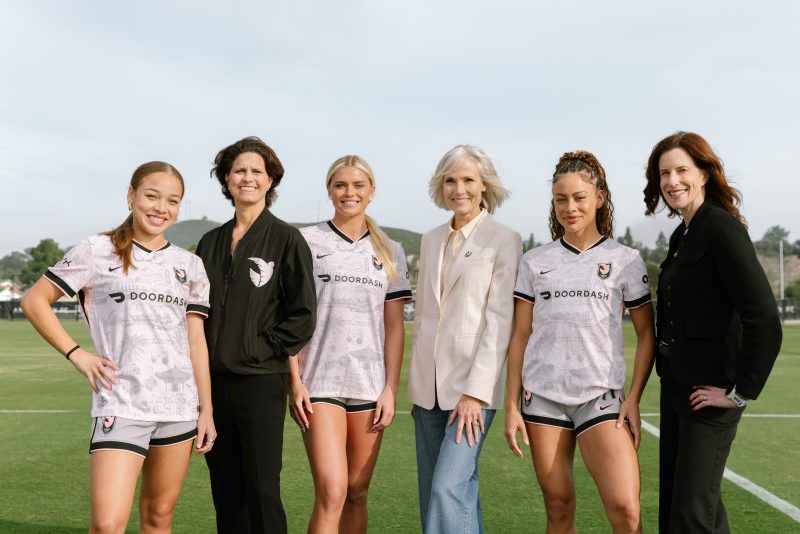
The Angel City Football Club is one of USA TODAY’s 2026 Women of the Year, a recognition of women who have made a significant impact in their communities and beyond. Meet this year’s honorees here.
If you’re heading to your first Angel City Football Club home game at BMO Stadium in Los Angeles, you will experience a vibe. Girls wearing too-large player jerseys − their dads in pink wigs. PodeRosas, a group of Spanish-speaking supporters, chanting, ‘Dale, dale, ACFC. Dale, Angel City.’
You’ll see grandmas and girlfriends. Celebrity owners and families. Huge flags in the team’s colors, black and Sol Rosa − a dusty pink representing the Southern California sun and horizon. The omnipresent bass drums will make you want to dance.
And when the home team scores, everyone will be on their feet.
Willow Bay, journalist and dean of the USC Annenberg School, remembers her first game. It was the team’s inaugural season, and it was electric. “I was blown away,” she says. “It just felt special. It felt different, and it felt joyful in a way that kind of took my breath away.”
That vibe inspired Bay, with her husband, Disney CEO Bob Iger, to acquire the club and become controlling owners. The move made Angel City one of the most valuable women’s sports team in the world, valued at $250 million. But that’s not the only reason the team is one of the most envied in all of women’s sports.
Making the impossible possible
The idea for a women’s soccer team in LA started not with a former athlete but with actress Natalie Portman. After watching her son cheer on players from the women’s World Cup, she reached out to Kara Nortman, a venture capitalist she knew from their work on Time’s Up, the women’s empowerment movement. Nortman knew entrepreneur Julie Uhrman, and together the three sat down to think about what it would take to launch a women’s soccer team.
“Back in 2019, the narrative was that nobody watched women’s sports. Nobody invested in women’s sports. Nobody cares about women’s sports,” says Uhrman, 51. LA was already an incredibly crowded marketplace with 11 professional sports teams. “Nobody believed it was possible.”
They had a lot of learning to do. “I had to look up the National Women’s Soccer League,” Uhrman admits. “I didn’t even know it existed.”
And there was no real business model to follow. “There was really only one professional sport where women athletes were paid and had media distribution, and that was tennis,” Nortman says. “There was no example of a women’s sports team that could drive revenue and cover costs and that could be more than a nonprofit.”
They were determined from the beginning that this would be a business. “Charities don’t always continue,” Nortman says. “To actually show that something can be self-sustaining, that’s how you ensure its survival. Angel City should outlive all of us. This is so much bigger than any of us, ever.”
Initially, they didn’t even have a team name. But they knew what they wanted it to be like to watch a game. “We wanted to build an experience that we wanted to go to, and we knew if we did that, fans would come,” Uhrman says. “We want our community to feel a connection to us and a sense of belonging.”
That meant showing up for their community. Part of what makes their business model unique is their 10% pledge: 10% of all sponsorship dollars go back to the community. To date, that’s nearly $8 million over the life of the club. The money has helped deliver more than 3 million meals to people who are homebound, and it funded Footy Fridays, where local kids receive free soccer coaching.
“We’re not just about winning and losing,” Uhrman says. “We’re about having this positive impact and building something together.”
It also meant protecting their players. When defender Sarah Gorden started out in the league, she was making just $8,000 as a single mom. “Having the club and people that care and want you to be the best mom and player you can be,” the center back, 33, says. “Really, we’ve come so far.”
Playing to win
Uhrman, who will step aside this year as CEO to be principal adviser to team owners, says starting Angel City was the biggest risk of her life. Now the team has the receipts: In year one, it sold 16,000 season tickets. “We were the first team to sell out stadiums in LA,” Nortman says. “We were the first team to really show this could work commercially.”
Bay, 62, recognized the opportunity. “There was never a question in my mind that this was a long-term, sustainable business,” she says. “This is a unique moment in sports history where women’s sports are driving the cultural conversation. They’re bringing new energy and excitement, frankly, to sports fans everywhere.”
Now, as controlling owner, walking into a game feels very different. She thinks about the experience through fans’ eyes; she worries about the athletes. “You go from being a fan, which is nothing but joy, to having a little anxiety about the game outcome,” she says.
Her taking the helm of the board was the first of several changes. In April a new head coach, Alexander Straus, was announced.
“For me, as an 11‑year professional, I’ve never seen so many changes in one season,” Gorden says. “That’s all really hard to navigate.” The team also was grappling with the sudden collapse of defender Savy King, 21, who in May had a heart attack during a match.
The headwinds brought out a tenacity in the team. ‘They’ve been my rock,” King says. “Every time I walked in the locker room I’d get swarmed with hugs. Now I’m alongside them on the field. It’s been absolutely incredible.” Gorden also saw something else emerging: stability. “It feels different, steady,” she says. “And building off a solid, steady foundation is so important when you’re trying to build a championship team.”
“Championship” is a word everyone is thinking about. The club has yet to win a title. And with investors like Alexis Ohanian, Eva Longoria, Jennifer Garner and Billie Jean King, there’s a bright spotlight on the team.
Nortman relishes the challenge. “I love being held to a higher standard. We built Angel City to drive women’s sports forward, to show what’s possible when you intentionally invest in the players, the product on the pitch, the game day experience in the community,” she says.
“There’s no secret sauce. We love leading because we know others will follow.”
In January 2025, the team opened a new practice facility at the site formerly used by the Los Angeles Rams. The multimillion-dollar renovations included performance technology, rehab rooms and children’s playrooms to support players and staff. The team also invested in coaching staff and players, including extending contracts with defender Gisele Thompson, 20, and Riley Tiernan, 23, who led the team in scoring last year as a rookie. Tiernan was part of the first NWSL class without a draft, something the player’s union pushed hard for, and chose Angel City for the team culture and the fans. “I think this season is going to be something really special,” she says.
King, who left UNC after her freshman year to join the NWSL, is thrilled to be playing for Angel City and in front of her hometown. “As soon as I heard that LA was going to have a team − I think I was in high school when that happened − I knew that this was a place where I had to play,” she says. “The club is such a big part of this community. It’s such an amazing thing.”
There’s only one thing left for them to do: “Win a championship for Los Angeles,” Bay says. “And then do that repeatedly.”
The fans will be cheering.
Wendy Naugle is USA TODAY’s Executive Editor of Entertainment. Follow her on Instagram @wendy_naugle.
