
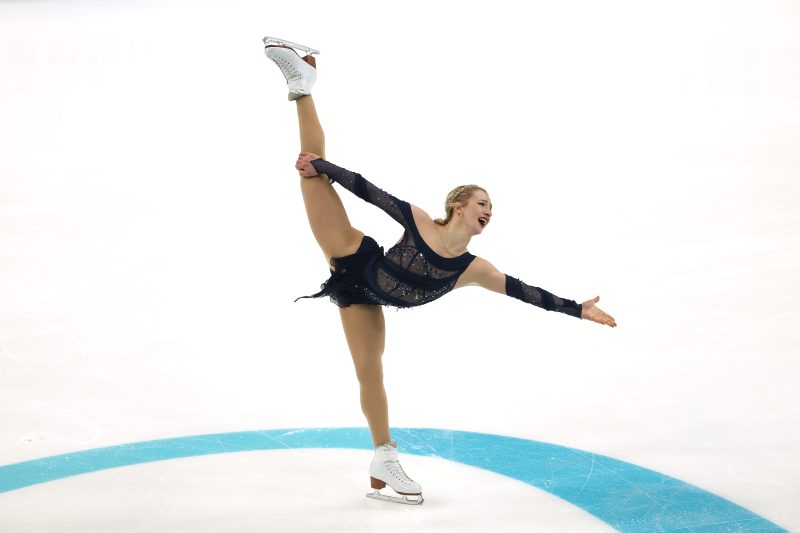
- Amber Glenn, Alysa Liu, and Isabeau Levito will represent the U.S. in women’s figure skating at the 2026 Milan Olympics.
- An American woman has not won an Olympic figure skating medal since Sasha Cohen’s silver in 2006.
- Amber Glenn won her third consecutive national title at the U.S. championships, a first since Michelle Kwan.
ST. LOUIS — They are friends rather than rivals. They finish each other’s sentences and laugh at each other’s jokes. They stand by the ice and cheer for one other. These three people, great American figure skaters all, are having so much fun that it’s easy to ignore just how formidable an athletic trio they have become.
Amber Glenn, Alysa Liu and Isabeau Levito, the three women who will go to Milan on the 2026 U.S. women’s Olympic figure skating team, will form the greatest American women’s Olympic squad since around the turn of the 21st century, during the Michelle Kwan era, when American women always won Olympic medals.
Since those days, it has been rough going for U.S. women at the Olympics. In fact, it has been 20 years since an American woman won an Olympic figure skating medal — Sasha Cohen’s silver in 2006 — but if the plethora of stellar performances in the women’s long program Friday night at the U.S. championships is any indication of what’s to come in Italy, that drought is about to end.
In fact, Glenn said as much after winning her third consecutive national title, the first U.S. woman to do that since Kwan.
“All we’ve got to do is do our job,” said the 26-year-old Glenn, whose first trip to the Olympics comes after years of perseverance and patience in this confounding sport. “As long as we do our programs to the best of our abilities, we cannot control the outcome, but I think the U.S. ladies have come so, so far in the last two decades that if all three of us do our jobs in Milan, then more than likely someone’s going to be up there (on the medal podium). But I think as long as we all stick to what we do best, then we will break that drought.”
They certainly stuck to the script here this week, with one scintillating program after another skated with flair and confidence, and without mistakes, in both Wednesday’s short program and Friday’s long. Although Glenn, Liu and Levito are nowhere near as well known as Kwan and her competitors — Tara Lipinski, Sarah Hughes and Sasha Cohen — they performed under pressure just like the old guard used to. The past three days here, it was like 1998 or 2002 all over again in U.S. women’s skating, but with tougher jumps.
When it was over, Glenn won with 233.55 points, followed by Liu with 228.91 and Levito with 224.45.
Milan Magic: Listen on Apple, Spotify or wherever you get your podcasts.
For decades, there was arguably no more valuable gold medal to be won by an American at an Olympics, winter or summer, than the one given out in women’s figure skating. And Americans got very good at winning it. These names still are some of the most recognizable in sports, at least to their generation: Tenley Albright (1956), Carol Heiss (1960), Peggy Fleming (1968), Dorothy Hamill (1976), Kristi Yamaguchi (1992), Tara Lipinski (1998) and Sarah Hughes (2002).
And then it stops. That’s it. Skaters from Russia, Japan and South Korea have done the winning over the past two decades, not Americans. Skaters like Mirai Nagasu, Gracie Gold and Ashley Wagner got close, but didn’t quite reach the podium.
But this group — Glenn, Liu and Levito — feels different. Perhaps it’s just the early exuberance of a spectacular nationals competition. But all three of those women will arrive at the Olympics having won national titles: Glenn with her three, Liu with two and Levito with one.
Get Olympics updates in your texts! Join USA TODAY Sports’ WhatsApp Channel
Also, for the first time since 2002, the United States will be sending a women’s world champion, Liu — the reigning world champion at that — to the Olympics. The last time that happened at an Olympics was 2002 with Kwan.
These will be heady days for U.S. women’s skating. Predictions will abound. Can one of the three Americans win the gold? Can the U.S. win two of the three women’s medals, as they did most recently in 1998 and 2002? Will one of the three be able to fend off a strong contingent of Japanese women and the latest Russian star, the only Russian female skater who has been allowed into the Games, Adeliia Petrosian?
In February, this conversation gets very real. For now, the possibilities are a long-awaited delight.
